

PLATFORM · DOCUMENT PROCESSING
Every Document. Classified, Verified, and Filed in Seconds.
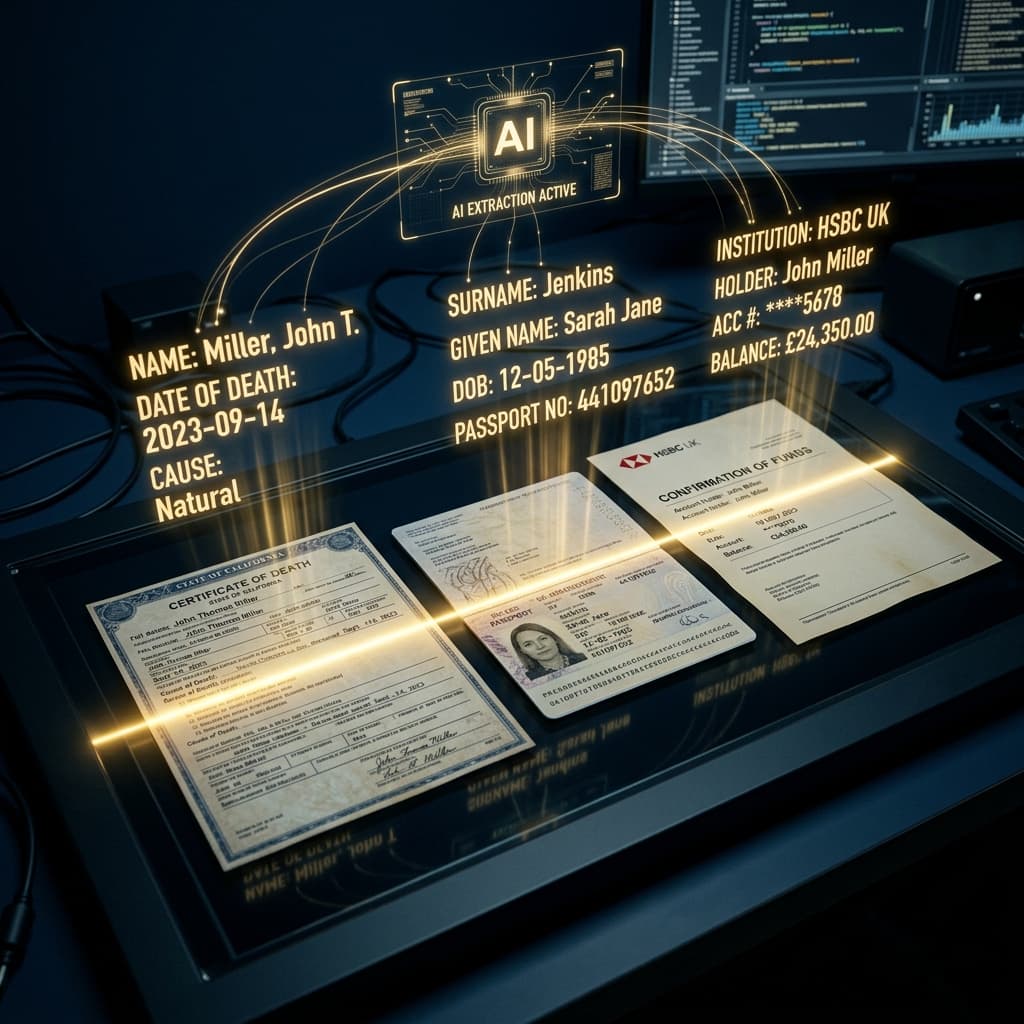
EarCodeX's document-processing engine reads, classifies, and cross-validates every policy schedule, every claim form, every death certificate, and every bank confirmation the moment it enters the platform.
BI-1663 · BURIAL ORDER · BANK CONFIRMATION · CERTIFIED ID · AUTOMATED OCR

TheDocumentBottleneckThatCostsYouHoursEveryDay
Every insurance claim arrives as a stack of documents: death certificates, certified identity documents, BI-1663 forms from the Department of Home Affairs, proof of banking details, burial orders, and policy schedules. In a manual environment, a single claims clerk must identify each document by visual inspection, key the relevant data fields into the administration system, cross-reference each field against the policy record, and file the document into the correct folder.
For a single claim with five documents, this process takes between fifteen and forty-five minutes. At scale — an administrator processing two hundred claims per week — this means one or two full-time staff members are dedicated entirely to document processing. And the error rate on manual data entry is consistently between two and five per cent, meaning that between four and ten claims per week contain at least one incorrectly captured field.
These errors cascade. An incorrect identity number means a failed Home Affairs verification. A miskeyed policy number means a claim routed to the wrong policy. A banking detail transposition means a payment to the wrong account. Each error generates a correction cycle that adds days to the claim timeline and cost to the operation.
Classification,Extraction,Validation—inUnderThirtySeconds
EarCodeX's document-processing engine uses a four-stage pipeline architecture that replaces the manual workflow entirely. Documents are uploaded via the web interface, the mobile app, or WhatsApp — in any format: PDF, JPEG, PNG, or photograph.
- ◈Stage 1 — Classification: A convolutional neural network trained on over fifty thousand South African insurance documents identifies the document type with 98.6% accuracy across twelve document categories.
- ◈Stage 2 — Extraction: Optical character recognition extracts the text content, and a named-entity recognition model identifies key data fields: identity number, policy number, date of death, banking details, and cause of death.
- ◈Stage 3 — Validation: Extracted fields are cross-referenced against the policy record in real time. Any inconsistency — a mismatched identity number, a date of death before policy inception, or banking details that differ from the record — is flagged immediately.
- ◈Stage 4 — Filing: The verified document is filed into the correct claim or policy folder with an immutable timestamp and a complete audit trail.

FromUploadtoVerifiedinFourStages
The entire pipeline executes in under thirty seconds per document. A five-document claim that would take forty-five minutes manually is processed in under three minutes with higher accuracy.
Upload
Documents arrive via web portal, mobile app, email, or WhatsApp in any common format.
Classify
AI identifies the document type — death certificate, BI-1663, ID, bank letter, burial order, or policy schedule.
Extract
OCR reads every field. Named-entity recognition isolates policy number, ID number, dates, and banking details.
Validate and File
Extracted data is cross-checked against the policy record. Verified documents are filed with an immutable audit trail.

A Pretoria Administrator's Transformation
“Before EarCodeX, our document processing team was three people working full-time just to handle the daily intake. Claims would queue for two to three days before a clerk even opened the documents. Now, by the time my assessor opens a claim, the documents are already classified, the data is extracted, and any missing items are flagged. We reassigned two of those three people to client-facing roles.”
“The accuracy improvement was the real surprise. We used to find data-entry errors in about one in twenty claims. With the automated extraction, we are seeing errors in fewer than one in a hundred.”
— Operations Manager, funeral insurance administrator, Pretoria (anonymised)
TheNumbersThatMatter
These metrics are drawn from live production data across administrators currently on the EarCodeX platform.

See Document Processing in Action
Upload a document in the demo environment and watch the AI classify, extract, and validate in real time.